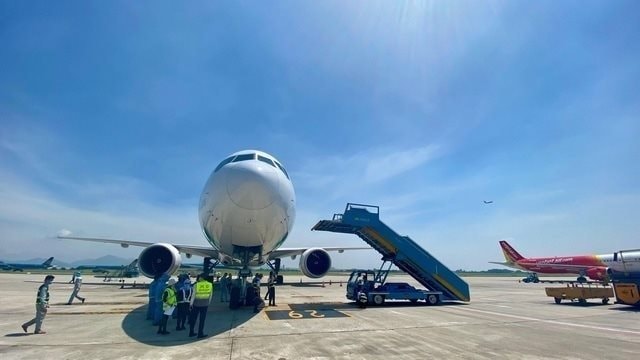
The global aviation industry is striving to achieve carbon neutrality through the Carbon Offsetting and Reduction Scheme for International Aviation (CORSIA), which will lead to an increased demand for carbon credit in the future.
Regarding this issue, the Natural Resources and Environment newspaper interviewed Ms. Nguyễn Hồng Loan - Climate Change Policy and Carbon Market Specialist, Director of Green Climate Innovations Co., Ltd. (GreenCIC), to clarify the impacts of CORSIA on Vietnam.

Ms. Nguyễn Hồng Loan - Climate Change Policy and Carbon Market Specialist, Director of Green Climate Innovations Co., Ltd. (GreenCIC)
Reporter: Could you please share more about CORSIA and whether Vietnam is required to participate in this program?
Ms. Nguyễn Hồng Loan: According to the report from the Intergovernmental Panel on Climate Change (IPCC), the aviation sector accounts for approximately 2% of total global greenhouse gas (GHG) emissions caused by human activities. Data from 2015 showed that around 65% of fuel consumption in the aviation sector was used for international flights. Thus, international aviation is responsible for about 1.3% of total global GHG emissions.
However, under the Paris Agreement of the United Nations Framework Convention on Climate Change (UNFCCC), GHG emissions from international aviation are not considered in the GHG reduction targets outlined in each country's Nationally Determined Contributions (NDC). Therefore, the International Civil Aviation Organization (ICAO) has set a goal of achieving carbon-neutral growth from 2020 and implementing CORSIA to contribute to the Paris Agreement's goals.
CORSIA is the first global sectoral program based on the market to help ICAO achieve its carbon-neutral growth goal from 2020. CORSIA allows for the use of valid carbon credits to offset remaining GHG emissions after airlines implement technology improvements, operational changes, and fuel switching to reduce GHG emissions.
Starting in 2021, CORSIA entered its pilot phase, where voluntarily participating airlines must maintain GHG emissions from international flights at the baseline level set in 2019. The current phase, the first implementation phase (from 2024-2026), aims to reduce emissions to 85% of the baseline level.
In the second implementation phase, from 2027-2035, in addition to voluntary participation, CORSIA will be mandatory for all countries with international aviation activity greater than 0.5% of total activity in 2018 or contributing to 90% of total aggregated activity according to RTK (Revenue Tonne Kilometers). Thus, Vietnam is on the list of countries that will be required to implement CORSIA starting in 2027.
ICAO has also announced valid emission units under CORSIA to assist airlines in achieving their emission reduction targets. The most recent update in March 2024 specifies the valid emission units for the 2024-2026 period.
Reporter: With participation in CORSIA, the aviation industry could be seen as the first major customer for domestic carbon credits, clearly reflecting the real demand for this commodity. What types of credits are compatible with CORSIA that Vietnam currently has?
Ms. Nguyễn Hồng Loan: During the pilot phase from 2021 to 2023, ICAO approved many existing carbon credit project types in Vietnam under standards such as the Clean Development Mechanism (CDM), Gold Standard (GS), and Verified Carbon Standard (VCS). Carbon credits from these mechanisms are permitted for use under CORSIA during the pilot phase. Currently, Vietnam has approximately 40 million carbon credits issued from these mechanisms.
For the period from 2024 to 2026, CORSIA has only approved two types of carbon credits: credits from the American Carbon Registry (ACR) and forest carbon credit standards (Architecture for REDD+ Transactions - ART). Among these, Vietnam is implementing a Emission Reduction Purchase Agreement for forests in 11 provinces of the Central Highlands and South Central Coast under the ART standard, with a total volume of 5.15 million tons during the 2022-2026 period. Additionally, voluntary standards such as GS, VCS, and GCC have also submitted applications for recognition as valid for CORSIA during this period.
Thus, registered projects under these standards in Vietnam have the potential to provide carbon credits to meet the offset requirements under CORSIA in the near future. However, it is important to note that the general condition for all valid carbon credits under CORSIA is that they must be issued from projects with a crediting period starting from January 1, 2016, and the credits must represent GHG reductions generated from January 1, 2021. Furthermore, these carbon credits must also receive a Letter of Approval from the host country to allow for international transfer and corresponding adjustment to the domestic GHG reduction target.
 Reporter: How do you assess the demand for voluntary credit as well as the supply potential from domestic projects to serve compliance with obligations and regulations in international carbon markets?
Ms. Nguyễn Hồng Loan: As of April 2024, Vietnam has 274 registered projects under the CDM mechanism, 43 projects under the VCS, and 45 projects under the GS, making it one of the leading countries in the number of carbon credit projects registered under international carbon credit mechanisms. Additionally, projects enhancing carbon sequestration from forests and low-emission rice cultivation in Vietnam also have significant potential to generate carbon credits in the future.
Domestic carbon credits can supply potential carbon markets such as: i) the mandatory domestic carbon market (the cap-and-trade market for emissions and carbon credits regulated by the Environmental Protection Law and Decree No. 06/2022/ND-CP on mitigation of greenhouse gas (GHG) emissions and protection of ozone layer), ii) the voluntary domestic carbon market (the market providing carbon credits for voluntary GHG emission reduction targets and corporate ESG objectives in Vietnam). Domestic traded carbon credits will not affect the country's GHG reduction targets under NDC.
Moreover, as mentioned above, domestic carbon credits can be used to achieve the NDC of other countries or for other international mitigation purposes such as CORSIA. Currently, countries like Japan, South Korea, and Singapore are in negotiations to purchase carbon credits from Vietnam to offset their GHG emission reduction targets. It is projected that the demand for carbon credit from international carbon markets could reach 5-11 billion tons of CO2 mitigated annually by 2030. Airlines may need 100-200 million credits for the first phase of CORSIA from 2024 to 2026. To meet these purposes, carbon credits will have to be correspondingly adjusted and will no longer count towards Vietnam's NDC target. Therefore, careful management of international carbon credit sales that require corresponding adjustments to the NDC target is necessary, as excessive sales could impact the country's GHG emission reduction commitments.
However, Vietnam also needs to consider urgent international GHG offsetting obligations like CORSIA to build appropriate strategies for managing carbon credits participating in international carbon markets. An effective carbon credit management strategy will help domestic companies needing to purchase carbon credits for international transfer, such as domestic airlines required to comply with CORSIA, to purchase carbon credits in Vietnam rather than from other countries. Additionally, an effective carbon credit management strategy can help Vietnam attract support from international climate finance sources to enhance the achievement of its GHG emission reduction targets. As of March 2024, only 7.14 million carbon credits from the ART TREES project in Guyana are eligible for offsetting under CORSIA, sold at a floor price of 20 USD/credit, which increased to 23 USD/credit in April 2024.

Reporter: Vietnam's aviation industry is expected to participate in CORSIA starting in 2026. In your opinion, how should Vietnamese airlines with international routes prepare when there is only a little over a year left?
Ms. Nguyễn Hồng Loan: Some Vietnamese airlines with international routes have already had to fulfill obligations to pay for GHG emissions when flying through regions that apply carbon pricing systems for aviation, such as European countries. Additionally, the obligation to Measure, Report, and Verify (MRV) GHG emissions from international flights under CORSIA has been applied by ICAO since 2019.
However, in the near future, if Vietnam plans to participate in CORSIA in 2026, airlines will have the opportunity to better prepare for compliance with this mechanism before mandatory participation.
It should be noted that with participation in CORSIA, the scope of GHG emissions from international aviation that must comply with GHG reduction obligations will be much larger than before. Currently, there are 216 countries voluntarily participating in CORSIA, and this number will undoubtedly continue to increase along with the growing international community's efforts to reduce GHG emissions. Therefore, in the near future, airlines need to estimate their growth scale and forecast GHG emissions from their international aviation operations and determine the scope of CORSIA compliance. Airlines need to research measures to reduce GHG emissions, including adopting sustainable fuels, technological and operational solutions, and solutions for investing in or purchasing valid carbon credits to offset emissions under CORSIA in the market. Airlines need to evaluate the costs and benefits of each specific measure and build strategies and specific plans to comply with CORSIA at each phase.
There is no one-size-fits-all solution for all airlines. Each airline needs to base its preparation plan on its technological and operational status, financial conditions, and implementation capacity.
Reporter: Thank you very much!
Khánh Ly